
In recent years, interior thermal insulation has become one of the most effective solutions for improving the energy efficiency of buildings, especially in cases where it is not possible to work on exterior facades. We are talking about a technique that makes it possible to reduce heat loss and improve living comfort without changing the appearance of the building or tackling invasive structural work.
The principle is simple: create a thermal barrier inside the home, capable of retaining heat in winter and keeping rooms cooler in summer. The goal is twofold: to reduce energy consumption and to keep walls dry and healthy.
By 2025, as materials and regulations evolved, interior coats had evolved into intelligent low-thickness, often reflective and breathable systems that provide results comparable to those of an exterior coat, with much less thickness.
(See also : How much does thickness matter in thermal insulation or Afontermo 7 in 1: the ingenious solution to avoid unnecessary thicknesses).
Index
- 1. What is interior thermal insulation and what is it for?
- 2. Advantages and limitations of interior thermal insulation
- 3. Thicknesses and materials: what is the minimum thickness of an interior thermal coat?
- 4. Breathability and comfort: avoid mold and condensation
- 5. Low-thickness interior coat: nanocoat technology
- 6. How to apply an interior thermal coat
- 7. Real results: thermography and indoor testing
- 8. Conclusions: the future of interior thermal insulation
1. What is interior thermal insulation and what is it for?
Interior thermal insulation is an insulation system that is applied to the interior surface of the perimeter walls of a building. Its purpose is to reduce heat loss through walls and improve the energy efficiency of rooms.
Unlike exterior coat, it requires no facade work or scaffolding, making it ideal for:
- condominium apartments with architectural or condominium constraints;
- Historic or listed buildings;
- Partial renovations of individual rooms (rooms, offices, attics).
Its effectiveness depends on three main factors:
- The thermal conductivity of the insulation material;
- The breathability of the wall (ability to pass vapor);
- The continuity of the insulation layer, which must avoid thermal bridges.
A well-designed interior coat improves winter comfort, limits the formation of condensation and mold, and contributes to savings on utility bills.
(See also : How many types of thermal insulation are there?)
2. Advantages and limitations of thermal insulation
The advantages of this solution are obvious:
- rapid and minimally invasive interventions, also ideal for inhabited buildings;
- Absence of scaffolding and heavy masonry work;
- Lower costs than an external coat;
- Immediate improvement of thermal and acoustic comfort;
- possibility of localized interventions (only on cold or north-facing walls).
However, interior coat also has some limitations, which must be managed with proper design:
- Risk of interstitial condensation if the material is not breathable;
- Minimal reduction of interior space;
- Need to avoid vapor barriers that hinder the natural diffusion of moisture.
To overcome these problems, low-thickness reflective and breathable materials are now used, capable of insulating without impeding the “breathing” of the wall.
(Read more : Thermal insulation techniques? Everything you need to know )
3. Thicknesses and materials: what is the minimum thickness of an interior thermal coat?
The effectiveness of a thermal coat depends not only on the thickness, but mainly on the properties of the insulation material. Conventional systems (EPS, XPS, rock wool, cork) perform well, but require large thicknesses to achieve significant results.
They also give various problems with regard to mold and condensation.
With the advent of nanotechnology and reflective materials, such as nanocoat, it is possible to achieve the same level of insulation with just a few millimeters of thickness. These products act not only by reducing heat conduction, but also by reflecting thermal radiation, improving efficiency in both winter and summer.
A concrete example is represented by Afontermo the Nanocap, Italy’s first and certified, reflective and breathable material that does not require an air chamber to function properly. Unlike opaque, high-emissivity insulation panels, reflective materials work on the radiant component of heat, keeping interior surfaces warmer and reducing the feeling of “cold” walls.
4. Breathability and comfort: avoid mold and condensation
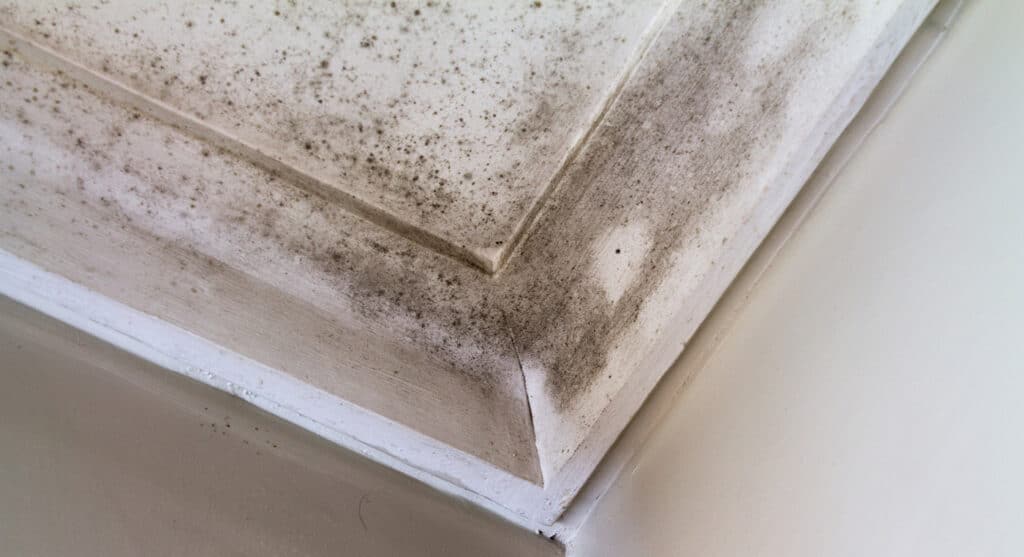
A wall must not only insulate but also breathe. If water vapor produced inside the home cannot properly diffuse to the outside, surface and interstitial condensation, the main culprits of mold, will form.
The breathability of a material is therefore a key parameter. Synthetic or vapor-barrier insulation can hinder the spread of moisture, generating water accumulation in cold spots. In contrast, a material with vapor permeability similar to that of masonry allows the gradual passage of vapor and keeps walls dry.
It is important to understand that the dew temperature (the point at which vapor condenses) depends on internal temperature and relative humidity: a reflective, thermal, and breathable material allows the surface temperature to be kept higher, warding off the risk of condensation.
(Read more : The importance of breathability in insulation or breathability with mathematical formulas and calculations)
5. Low-thickness interior coat: nanocoat technology
The nanocoat concept stems from the need to combine high thermal performance with minimal thickness. Unlike traditional systems, which focus on mass, nanocoat takes advantage of reflective microstructures to prevent heat loss.
Materials such as Afontermo represent an example of “7-in-1” insulation, capable of offering:
- winter thermal insulation;
- summer heat insulation;
- low thickness;
- fire resistance;
- impact resistance;
- breathability;
- Absence of joints or juxtapositions.
The combination of these features also makes it suitable for inhabited rooms, damp walls, ceilings, alcoves or places that are difficult to treat with rigid panels.
(See also : Afontermo: The Thermal and Reflective Mirror for Energy Efficiency.)
6. How is an interior thermal coat applied?
The application of an interior coat must be thorough and follow a precise sequence:
- Preparation of the substrate: cleaning, removal of old paint or inconsistent parts, possible use of breathable thermal skim co ats to level (e.g., Rasantermo-type skim coats).
- Application of insulation material: the product is spread or laid in several coats according to the technical directions.
- Surface finish: completion with Thermopaint which is a reflective, thermal and breathable paint that can amplify thermal performance and maintain a healthy microclimate.
In the presence of rising damp or walls against the ground, it is recommended to combine the insulation system with dehumidifying products (e.g., plasters such as Novomur) to ensure a durable and stable result.
(Read more : Interior thermal coat: thermal skim coat application)
7. Real results: thermography and indoor testing
Infrared thermography is the most reliable tool for verifying the behavior of an insulating material. Through thermal images, areas of leakage can be visualized and treated surfaces can be compared with uninsulated surfaces.
Thermographic studies conducted on reflective materials such as Afontermo show a clear reduction in heat loss and an increase in internal surface temperature, a sign that heat remains inside the room.
Indoor tests also confirm the effectiveness of thin coats: due to their ability to reflect thermal radiation, they improve not only energy efficiency but also people’s perceived comfort.
(See also : Does the nanocap really work? Technical evidence and calculations )
8. Conclusions: the future of interior thermal insulation
Interior thermal insulation is no longer a “stopgap” solution, but a real technologically advanced alternative to exterior insulation.
Thanks to advances in materials, it is now possible to insulate, breathe and save space at the same time, ensuring living comfort in every season.
Choosing a reflective, breathable system designed to work in balance with masonry means investing in comfort, efficiency, and durability.
In the landscape of modern renovations, interior insulation represents the new frontier of sustainable building: a smart, subtle solution that respects the existing structure.
For information on your specific case , you can contact us on the Contact page or search for your local distributor so you can book a free sopralloguo.
FAQ: Common Questions About Interior Thermal Coating
- Does the interior coat lose space?
Yes, but to a minimum extent: low-thickness systems require 3 to 10 mm of material, without changing the environments. - Can it be applied on damp walls?
Yes, but only if the moisture problem is first solved with dehumidifying plasters or specific treatments. - How long does an interior coat last?
A quality system, properly applied, maintains its performance for more than 20 years. - Can I use interior coat even in summer?
Yes. Reflective materials also act as a barrier to summer heat, improving comfort and reducing air conditioner use. - What is the minimum effective thickness?
It depends on the material: a reflective nanocoat can be effective as early as 4 to 12 mm, while a traditional panel requires at least 5 to 8 cm. - How much does interior thermal insulation cost?
The cost depends on the type of material chosen, the thickness and the surface to be treated. In general, a low-thickness system is more economical, both because of the reduced amount of material and because of the speed of installation, which limits time and labor. The presence of complementary products-such as skim coatings or heat-reflecting paints-can also affect the final price, but it guarantees a longer-lasting, better-performing result.